
NOW ACCEPTING NEW PATIENTS – BOOK A CONSULTATION
Threadlift at Verve Cosmetic Clinic. Speak with our team about lifting and supporting mild sagging without surgery.
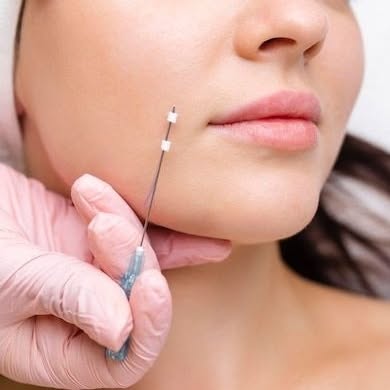
A threadlift uses absorbable sutures placed under the skin to reposition and support tissue that has begun to descend. The threads carry small barbs or cones that grip the tissue, and once anchored they hold it in a slightly lifted position. Over the following months the threads dissolve and the body lays down collagen along the path they took.
It produces a modest lift. It is not a facelift and it does not do what a facelift does. It is a medical procedure that carries risks, and it suits a narrower group of people than most advertising for it suggests.
Threadlifts are used at Verve for:
There is an immediate lift on the table, but it sits under swelling for the first week or two, so the settled result is generally clear at around three to four weeks. The effect typically lasts somewhere between twelve and eighteen months, and it fades gradually rather than suddenly. How long it holds depends on the tissue, the degree of descent at the start, and your own healing.
A threadlift does not stop ageing. Tissue continues to descend afterwards, and repeat treatment is generally needed to maintain the effect.
A threadlift is an invasive procedure and it carries risks that should be understood before you decide. Swelling, bruising, tenderness and a tight or pulling sensation are expected for the first one to two weeks. You will be asked to avoid strenuous activity, wide mouth opening, dental work and sleeping on your side for a period.
Less common risks include visible dimpling or puckering of the skin where a thread has caught, asymmetry, threads becoming palpable or visible under thin skin, threads migrating or working their way out through the skin, infection, prolonged pain, and, rarely, injury to a nerve causing temporary weakness or altered sensation. Some of these need the thread to be removed. It is also possible the lift achieved is less than you were hoping for.
A threadlift is not appropriate during pregnancy or breastfeeding, over active skin infection, where there is significant skin excess, or where you have certain autoimmune or bleeding conditions. The risks that apply to you are discussed in full at your consultation. This information is general and is not a substitute for individual medical advice.
A threadlift suits people with early, mild descent and reasonable skin quality, who want a modest change and understand it is temporary. It suits a narrower group than most people expect. Where there is significant sagging or loose skin, the threads have nothing to hold and the result disappoints, and surgery is the honest answer. Dr Nasser will tell you which of those applies to you.
Individual results vary from person to person. What is realistic for you is assessed at your consultation.
Local anaesthetic is used, so you should not feel sharp pain during the procedure, though you will feel pressure and pulling. Afterwards there is soreness and a tight sensation for one to two weeks.
Swelling and bruising for one to two weeks, and a tight or pulling feeling when you move your face. You will be asked to avoid strenuous activity, wide mouth opening, dental work and sleeping on your side for a period. Full instructions are given before you leave.
A considered approach to aesthetics begins with expert guidance.
Meet with Dr Alia Nasser and our experienced team for a comprehensive consultation, where we take the time to understand your goals, assess your concerns and create a bespoke treatment plan.